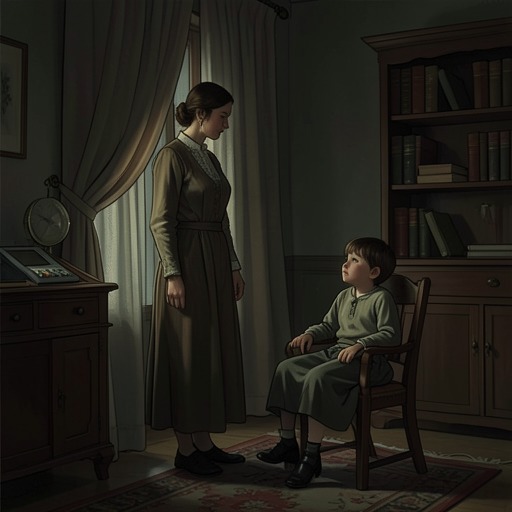
The blurred boundary between good and evil
The Last Thing He Told MeThe blurred boundary between good and evil emerges through the opposed accounts of Nicholas Bell and Owen Michaels. Nicholas is implicated in grave crimes, yet appears gentle and presents himself as a devoted family man; Owen, who helped expose him, is also accused of causing profound harm through choices made in the name of protection. The novel does not make these claims morally equivalent. Instead, it shows how love, loyalty, grief, and self-justification can complicate the judgment of people whose actions have damaged others.
Family Virtue and Criminal Complicity
Nicholas’s history resists a simple division between a respectable family life and criminal conduct. As Grady Bradford explains it to Hannah Hall, Owen long believed that Nicholas was a defense attorney who served questionable clients but committed no crimes of his own. Kate and Charlie, who loved their father and regarded him as a good father and husband, helped sustain that belief. Their affection was not necessarily false: the account allows that Nicholas could genuinely fulfill those family roles while also being complicit in murder, extortion, and drug trafficking, and while remaining unrepentant about the lives his actions had damaged.
That coexistence is central to the concept. The evidence does not erase Nicholas’s responsibility because he was loved, nor does it require the family’s love to have been an illusion. Instead, the same person can be experienced as a caring parent and implicated in brutal criminal activity. The distinction between what Nicholas was to his family and what he did beyond it is not a clean boundary separating two different men. It is a contradiction the people who loved him had to live with, and that Owen was slow to accept.
The Gentle Appearance and the Violent Record
When Hannah finally meets Nicholas, his physical presentation intensifies the conflict between appearance and knowledge. He is thin and frail-looking, with crooked, arthritic fingers, loose-fitting jeans, and a cardigan. His slow, soft manner and dry humor bring Hannah to mind of her own loving grandfather. Nicholas talks about pillars his wife bought from a monastery in France, explaining how an artisan restored them, and he gently introduces his dogs, Casper and Leon. These details make him legible as an elderly family man rather than as the figure Hannah has been led to expect.
His genuine, generous smile unsettles Hannah more than a clearly false display would have. She cannot reconcile that warmth with what she knows, or understand how Owen could have believed Nicholas a good man while loving Kate, Nicholas’s daughter. The scene does not establish that Nicholas’s tenderness is an act; equally, tenderness does not disprove the account of his crimes. The gap between a familiar, affectionate manner and a destructive record becomes a practical problem of judgment: what can outward gentleness establish, and what does it leave untouched? His dogs and the restored pillars make the encounter particular, but neither supplies an answer to the moral question.
Competing Accounts of Harm
Nicholas turns the question of moral responsibility back on Hannah by invoking Bailey Michaels, the child separated from her family after her mother died. He asks her to consider the cost of depriving Bailey of people who could have reminded her of her mother and of relatives who loved her. Hannah recognizes that Nicholas has led their conversation toward this accusation: he wants her to confront the harm Owen caused, rather than simply assess Nicholas by the harm his employers caused. His grievance is not invented merely because it is useful to him. But the validity of that grief does not absolve him of his own choices.
Nicholas also calls Owen hypocritical, arguing that Owen knew what Nicholas did and did not do for his employers, understood more than Nicholas’s children because of his knowledge of computers and encryption, and became close enough to help him with certain tasks. Hannah cannot answer from a position of uncomplicated moral superiority. She sees that Nicholas considers himself both a family man and a wronged man, and that he considers Owen guilty of betrayal. Rather than accept Nicholas’s entire account or argue against every part of it, she acknowledges the point she can accept and changes direction. Her response registers the difficulty of disentangling a real injury from the larger case Nicholas makes for himself.
Grief, Loyalty, and the Limits of Judgment
The deepest divide concerns what Nicholas believes he owed his family and what Owen believed he had to do. Nicholas recounts that Kate’s boss, a judge, was preparing an opinion against an energy corporation that would require nearly six billion dollars in conservation improvements. The day after Kate was killed, the judge found a bullet in his mailbox. Nicholas presents the timing as evidence that the judge had been threatened, while maintaining that the men he had protected would not have targeted his daughter and that even their more criminal associates would not act in that way without cause. Owen, whom Nicholas calls Ethan, refused to accept that reassurance and blamed Nicholas.
Nicholas interprets Owen’s accusation through the devastation of losing a child. He says he had spent six and a half years in prison rather than risk his family by revealing his employers’ secrets; in his telling, that silence was also understood by those employers as loyalty, and they continued to treat him as family after his retirement. These facts show how allegiance can acquire opposed moral meanings: to Nicholas, concealing secrets protected his family and honored a code; to Owen, that same protection concealed responsibility and made Nicholas answerable for what his associates had done. The evidence does not establish that Nicholas’s suspicions about the judge or his employers are correct. It does establish that grief and loyalty shape his interpretation, just as Owen’s closeness to Kate and Charlie had once made it difficult for him to accept the truth about their father.
Narrative Significance
The concept is not a claim that good and evil are indistinguishable, or that the suffering caused by criminal acts can be balanced against private kindness. The account names Nicholas’s complicity and lack of repentance even as it recognizes his family attachments and grief. It also allows his accusation against Owen to carry weight without treating it as a full defense. Moral judgment remains possible, but it cannot depend solely on whether someone appears kind, loved their family, or suffered loss.
By placing Hannah between Grady’s warning and Nicholas’s intimate counterstory, the narrative makes understanding a test of discernment rather than a choice between a spotless hero and a wholly monstrous enemy. Nicholas’s softness is real within the encounter; so is the violence and harm attributed to him. Owen’s actions may have exposed wrongdoing while also causing damage to a bereaved child and her family. The boundary between good and evil is blurred here not because consequences cease to matter, but because care and culpability can belong to the same person—and because the people who tell the story of their own choices may be both genuinely wounded and deeply implicated.